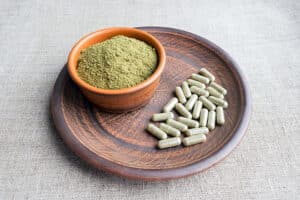
A package labeled “7-OH,” “7-hydroxymitragynine,” or even “kratom extract” may seem to tell you exactly what you’re getting. But those labels do not necessarily reveal how concentrated the 7-OH is, how it was produced, whether the amount matches the label, or what other active compounds are present. Recent laboratory analyses have found substantial differences between some commercial 7-OH products and traditional kratom, raising questions about what people are actually consuming.
7-OH does occur naturally in kratom, but only in relatively small amounts. The concern surrounding many commercial products is that they can contain much higher concentrations of 7-OH produced through additional processing. The FDA specifically distinguishes products containing added or enhanced 7-OH from the trace amounts naturally present in kratom. Research published in 2026 also found evidence that the overwhelming majority of 7-OH-labeled products examined in one analysis were semisynthetic in origin.
That difference matters because the name on the package may not tell the full story. Laboratory testing of some products has found higher-than-labeled 7-OH concentrations, chemical profiles that did not resemble natural kratom leaf, and additional constituents not identified in native kratom. Understanding those differences can help explain why health officials have drawn a line between traditional kratom and concentrated 7-OH products and why knowing exactly what is in a product can be difficult.
7-OH Products Are Not the Same as Natural Kratom
Although 7-OH is associated with kratom, a concentrated 7-OH product and natural kratom leaf are not chemically equivalent. Kratom contains a mixture of naturally occurring alkaloids, with mitragynine serving as its primary alkaloid and 7-OH appearing in much smaller quantities.
Laboratory testing has made that difference particularly clear. In a study of products marketed as “kratom extracts,” researchers found unusually high levels of 7-OH alongside relatively low amounts of mitragynine. The tested products also lacked several other alkaloids characteristic of natural kratom leaf. Based on their chemical profiles, the researchers concluded that the products were significantly different from authentic kratom and that the high 7-OH levels could only have been achieved through synthetic processing.
A separate 2026 analysis reached a similar conclusion. Researchers examining 7-OH-labeled products found that more than 98% showed evidence of semisynthetic origin, meaning the finished 7-OH was produced through chemical processing rather than simply extracted at its naturally occurring concentration from kratom leaf. The researchers also detected mitragynine pseudoindoxyl and several oxidation byproducts in the products they analyzed.
What Has Laboratory Testing Found in 7-OH Products?
Laboratory testing provides a clearer picture of how some commercial 7-OH products differ from what their packaging may suggest. One 2026 study analyzed eight products labeled as “kratom extracts” and compared their chemical profiles with authentic kratom leaf. Researchers found several notable differences:
- High Concentrations of 7-OH: The products contained between 22 and 75 milligrams of 7-OH per gram of dry weight, levels far above what occurs naturally in kratom leaf. Researchers concluded that concentrations this high could only have been achieved through synthetic processing.
- More 7-OH Than the Labels Indicated: When researchers compared laboratory measurements with the amounts claimed on the packages, the tested products contained 5% to 28% more 7-OH than their labels stated. That means a person relying on the package to judge how much they were taking could have consumed a larger amount than expected.
- Significantly Less Mitragynine Than Expected: Mitragynine is normally the predominant alkaloid in kratom. Yet the tested products contained only 2 to 6 milligrams of mitragynine per gram, substantially less than researchers would typically expect to find in kratom leaf or extracts.
- Chemical Profiles That Did Not Resemble Natural Kratom: The products lacked other major alkaloids normally present in kratom leaf. When researchers compared the products with authentic kratom, their overall chemical profiles were inconsistent with the natural plant.
- Other Unidentified Constituents: Testing also detected chemical peaks that were not found in native kratom leaf. The researchers did not identify all these constituents, so this finding should not be interpreted to mean that specific contaminants or other drugs were present. It does show, however, that the tested products contained more than simply the expected natural kratom alkaloid profile.
Why a “Kratom Extract” Label Can Be Misleading
The term “kratom extract” can give the impression that a product is simply a more concentrated form of natural kratom. For some 7-OH products, laboratory evidence suggests that description does not accurately reflect what is inside.
Extracting kratom typically means concentrating compounds already present in the plant. A high-concentration 7-OH product, however, may involve chemically converting mitragynine into 7-OH or otherwise processing kratom-derived compounds to produce concentrations that do not naturally occur in the leaf. Research showing semisynthetic origins in commercially labeled 7-OH products further supports this distinction.
The FDA also distinguishes concentrated or enhanced 7-OH products from natural kratom. This is important because terms such as “kratom-derived,” “kratom extract,” or “botanical” can describe where a compound originated without fully explaining how the finished product was processed or what concentrations it contains.
Can You Trust the Amount of 7-OH Listed on the Label?
A label can provide useful information about what a 7-OH product claims to contain, but laboratory research suggests that the stated amount should not always be treated as an exact measure of what is actually in the product. Unlike an FDA-approved medication, 7-OH products have not gone through the agency’s drug-approval process to establish standardized dosing, safety, and effectiveness. The FDA states that there are no FDA-approved products containing 7-OH.
As we highlighted above, one laboratory analysis found measurable differences between label claims and actual 7-OH concentrations. This matters because 7-OH has opioid-like effects. If a product contains more 7-OH than its label indicates, someone could consume a higher amount than they intended. Differences between products can also make it difficult to assume that switching from one formulation to another will produce equivalent effects.
Labels may also describe active ingredients differently. FDA warning letters have documented products labeled with varying amounts and combinations of 7-OH, including products declaring both 7-OH and mitragynine pseudoindoxyl. That means looking only at the number next to “7-OH” may not tell you whether other opioid-active kratom-related compounds are also present.
What Should You Do If You Don’t Know What’s in a 7-OH Product?
When the exact ingredients, concentration, or manufacturing process are unclear, it is safest not to make assumptions based on packaging or previous experience with another product. The FDA recommends avoiding products containing added or enhanced 7-OH because of concerns about serious adverse effects and dependence.
A few precautions are particularly important:
- Don’t assume similar labels mean similar products. Two products labeled “7-OH” or “kratom extract” may contain different concentrations or combinations of active compounds. Laboratory testing has shown meaningful differences in both 7-OH content and overall chemical profiles among tested products.
- Keep the original packaging if you experience a reaction. Ingredient lists, labeled amounts, brand information, and lot numbers may provide useful information to healthcare providers or poison-control specialists trying to understand what was consumed.
- Take serious symptoms seriously. If someone becomes unresponsive or is experiencing another medical emergency after using 7-OH, call 911. For questions about an exposure or adverse reaction, the FDA recommends contacting the Poison Help Line at 1-800-222-1222.
- Pay attention to patterns of dependence, not just the product label. If you need 7-OH regularly to avoid withdrawal, are using more than you intended, or are struggling to cut back, knowing the precise contents of every product may not resolve the larger concern. The FDA has received reports of withdrawal symptoms and addiction associated with 7-OH and recommends speaking with a healthcare professional when help is needed.
Frequently Asked Questions About 7-OH Products
Are 7-OH products made from kratom?
Some 7-OH may originate with mitragynine extracted from kratom, but the finished product can undergo additional chemical processing. A 2026 analysis of 7-OH-labeled products found evidence of semisynthetic origin in more than 98% of the products researchers examined. That means a product can be kratom-derived without having the same chemical composition as natural kratom leaf.
Is 7-OH the same as kratom extract?
No. A traditional kratom extract concentrates compounds naturally present in the plant, while many high-concentration 7-OH products contain levels that do not naturally occur in kratom.
What is mitragynine pseudoindoxyl?
Mitragynine pseudoindoxyl, sometimes abbreviated MP, is another kratom-related compound with activity at opioid receptors. It has been identified alongside 7-OH in commercial products and in laboratory analyses. The FDA has also identified mitragynine pseudoindoxyl as a synthetic kratom-related compound of concern. Its presence is another reason the term “7-OH product” may not describe every active compound in a formulation.
Can you become dependent on 7-OH even if you don’t know the exact dose?
Yes. Dependence is related to repeated exposure and how your body responds, not whether you know the precise number of milligrams you are taking. Needing 7-OH to avoid withdrawal, using increasing amounts, experiencing cravings, or having difficulty cutting back can all be reasons to speak with a healthcare professional.
Get the Help You Need for 7-OH Dependence at Brightside Recovery
Research shows that some 7-OH products are much more complicated than their labels suggest. Testing has found higher-than-labeled 7-OH concentrations, semisynthetic formulations, other opioid-active compounds, and chemical profiles that differ substantially from traditional kratom.
But if you are using 7-OH regularly, the exact chemistry of a particular product is only part of the concern. Experiencing withdrawal, cravings, increased tolerance, or difficulty cutting back may indicate that your use has developed into dependence.
Brightside Recovery offers an individualized 7-OH addiction treatment program for people who want help reducing or stopping their use. If you are concerned about your own 7-OH use or that of someone you care about, contact Brightside Recovery to learn more about available treatment options.