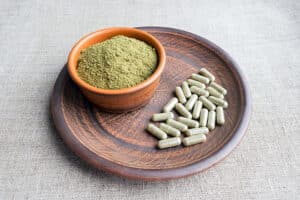
The U.S. Drug Enforcement Administration has finalized its temporary order placing synthetic derivatives mitragynine pseudoindoxyl, MGM-15, and MGM-16 into Schedule I of the Controlled Substances Act. Here’s the current status of this federal law enforcement action.
What Happened
On July 1, DEA filed its intent to temporarily place concentrated synthetic 7-hydroxymitragynine (7-OH), mitragynine pseudoindoxyl, MGM-15, and MGM-16 into Schedule I of the Controlled Substances Act.
The action targets products containing artificially elevated levels of synthetic 7-OH, including pills, gummies, powders, and liquid shots that have proliferated in gas stations, smoke shops, and convenience stores across the country.
DEA’s action is not directed at traditional natural kratom leaf that contains only trace, unenhanced levels of naturally occurring 7-OH.
DEA’s proposed threshold would generally cover products containing more than 0.050 percent 7-OH by dry weight, as well as certain products containing more than one milligram of 7-OH.
This distinction is critical. Natural kratom leaf and concentrated synthetic 7-OH are not interchangeable products. Concentrated synthetic 7-OH products are chemically manipulated to deliver opioid-like effects that bear little resemblance to the traditional plant.
Federal health and law enforcement officials have warned that these products pose serious risks, including tolerance, physical dependence, and addiction.
The Food and Drug Administration previously recommended that concentrated synthetic 7-OH be controlled because of its opioid properties, while making clear that its recommendation was not focused on natural kratom leaf.
Latest News
Now, DEA has finalized its temporary order placing mitragynine pseudoindoxyl, MGM-15, and MGM-16 into Schedule I. The order will be published in the Federal Register on Aug. 26, 2026 and will take effect immediately and remains in place through Aug. 26, 2028.
It is narrowly targeted: It applies only to mitragynine pseudoindoxyl, MGM-15, and MGM-16 — three synthetic compounds that do not occur in the kratom plant. The order does not schedule natural kratom leaf that has not undergone any post-harvest chemical manipulation.
DEA’s July 2026 notice also announced its intent to schedule concentrated synthetic 7-OH as part of this same effort; that action is still moving through the regulatory process and has not yet been finalized.
DEA is expected to finalize that order after the final comment period that ends on September 10 2026, which will put a stop to this rash of highly concentrated synthetic products that have proliferated across the U.S. over the past 3 years.
Frequently Asked Questions
Is concentrated synthetic 7-OH already a Schedule I drug nationwide?
Not yet solely because of DEA’s notice of intent. The announcement begins the temporary scheduling process. The federal Schedule I designation will take effect only after DEA issues and publishes its final temporary scheduling order.
What happens if I possess concentrated synthetic 7-OH after the order takes effect?
Once the temporary scheduling order becomes effective, knowingly possessing concentrated synthetic 7-OH products without lawful authorization could violate federal controlled-substance law.
Will stores still be able to sell concentrated synthetic 7-OH?
Once the final order takes effect, unauthorized manufacturing, distribution, and sale of concentrated synthetic 7-OH products will be prohibited under federal law. Retailers, distributors, and manufacturers should review DEA’s final order carefully and consult legal counsel regarding remaining inventory and compliance obligations.
Does this action ban natural kratom leaf?
DEA action is intended to target products with elevated levels of synthetic 7-OH, not traditional natural kratom leaf containing trace, unenhanced amounts.
The proposed thresholds are designed to distinguish concentrated synthetic 7-OH products from natural plant material. Federal officials have also stated that the action is aimed at concentrated and synthetic products rather than natural kratom leaf.
Consumers should nevertheless read product labels carefully. Some products marketed using the word “kratom” may actually contain concentrated or chemically manipulated 7-OH.